
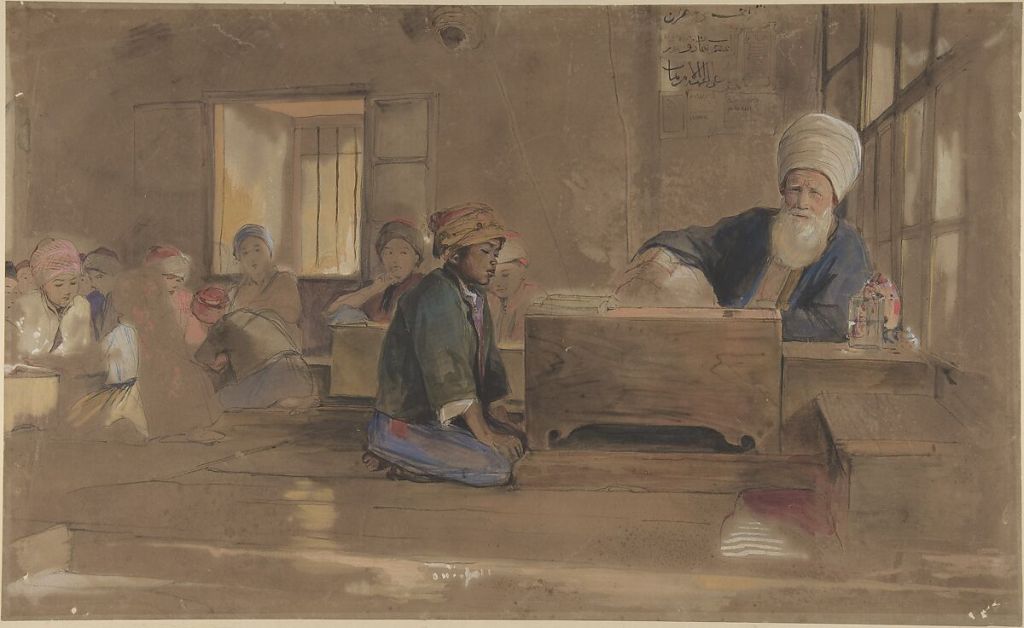
Imagine a group of people, either sitting down or standing up, dressed mostly the same. There is one person that stands or sits apart from them, dressed professionally. This simple image immediately evokes “instructor” or “teacher”—one person guiding people’s thoughts, behavior, or a mixture of both. This also immediately evokes “power”, “hierarchy”, “influence”. One party has a monopoly on attention and control.
In so many ways, the position of teacher can drive change and evolution. In so many ways, this position can be a force for good.
In this essay, however, I will explore how this position can be abused. I’ll use the word “teacher” to include the facets of “instructor” as well.
The term “abuse” here will be used broadly, meaning “using a lever of influence in a bad, harmful, or unnecessary way.” The Cambridge Dictionary defines it like this: “to use something for the wrong purpose in a way that is harmful or morally wrong.” The “something” in this essay will be “the position of a teacher.” I will use the term “educational abuse” to mean the abuse perpetrated by a teacher in the context of their role, and I’ll assume, importantly, it’s a generally ethically wrong thing to do, even if it is not directly harmful.
I will not address physical or sexual abuse by teachers, those being on another ethical level, one more straightforward to judge.
Important variables when it comes to educational abuse are the level of accountability a student has over their actions as well as the level of influence a teacher has over a class. For example, some forms of educational abuse can be seen as worse, ethically speaking, when the student is less accountable (insufficient instruction for a child vs. for an adult) or when the teacher has more influence over a student (a private tutor vs. a lecturer for hundreds). Or at least that’s an ethical argument that I want to make: the less accountable a student is, or the more influential a teacher is, the worse the educational abuse can be.
In reviewing my educational resume, and with what I’ve learned of the American educational system up until this point (M.Ed atm btw), I will identify and argue at least five forms of educational abuse. I’ll return to the argument of variables in educational abuse later.
Here are five heartbreaking scenarios:
- To guide in wrong thought.
In high school, I was taught wrongly about human evolution. I was given many stories and analogies that tried to prove that we’re too precious to have come from nature. In reality, the story of biology is much more interesting—and more true—than what I was taught.
Did this incorrect teaching have a huge bearing on my life? Not really. There are many things we can be wrong about that don’t result in “real-world consequences”. But beliefs can be tied to actions, so incorrect belief could lead to harmful action.
As a teacher, to instruct in incorrect thought is to take at least some responsibility for the actions of your students that are linked to that thought. This I believe is true even if the teacher earnestly believes the curriculum to be truthful. For example, if a teacher really believes and teaches that humans and other animals do not share genetic ancestry, then they nonetheless must take at least some responsibility if their student abuses animals, believing them to be alien and non-sentient.
Nevermind the animal abuser, what is the correct form of justice for the teacher, even the one who teaches genuinely and not out of malice? Incorrect instruction in thinking is a form of educational abuse.
In my case, I would say I suffered from this type of educational abuse, but it could have been worse if it were not for the following: in high school, I was already able to do some form of critical thinking for myself, the teachers were probably not evil in their intent, and they were teaching hundreds of us so students were not under any sort of thought surveillance other than peer pressure.
It’s not difficult to imagine the more destructive repercussions of teaching people incorrect information because it’s not difficult to imagine what people will do based on their beliefs. Many beliefs of the world are simply wrong, and many evil actions can be perpetrated based on those beliefs. We as teachers should not teach wrong ideas, and as soon as we find that established wisdom is untrustworthy, we must convene and change course.
- To guide in harmful or detrimental ways.
Here I distinguish teaching wrong information from teaching students in directly harmful or detrimental ways. Some ways that this form commonly manifests are in terrorist groups, cults, and other extreme political and religious organizations. It’s not difficult to imagine how the position of teacher can be used to cause direct destruction and chaos.
But most instances of this type of educational abuse are probably unintentional. For example, if a school system adopts a curriculum that is well-intentioned and grounded in some reality, yet poorly-organized and under-resourced, creating more chaos than order, this could result in teachers unintentionally guiding students in ways that ultimately jeopardize their potential.
I would argue this was the case during my teaching stint in public high school. In my essay The Ethics of Teaching: An Account and Some Important Questions, I wrote about what I called the alignment problem: the curriculum and teaching instructions that I was given did not align with the abilities of my students. If I were to have followed administrative instructions word for word, I believe I would have perpetrated this form of educational abuse, because students would have been oversaturated with content that was far above their level. This would have resulted in more time wasted, more progress stunted, and more confusion created.
To be clear, it’s not necessary that the instructional content itself cause harm. I was never ordered to teach a student something that would harm them. Rather, it was the design of the instruction—the level of difficulty, the pacing, the layout—that I believe would have been detrimental to student learning. There are ways to study good things badly, ways that can harm your future educational endeavors. Sometimes teachers teach these ways.
- To guide insufficiently.
Sometimes a teacher does not give a student what they need. The teacher might not themselves understand the material, or they may intentionally or unintentionally withhold some of the material, or they may fly through the material in a carefree way.
In this form of educational abuse, the student is not given incorrect information nor are they led to harmful action, they are simply not taught what needs to be taught. For example, in a mentor/mentee program, which many schools implement in order to onboard new teachers, the mentor teacher is tasked with guiding the mentee teacher in the school processes. If this ultimately does not happen, for whatever reason, then there are at least a couple of negative repercussions that could result. For one, the student (the mentee, in this case) could believe their misunderstanding is their own fault when it’s not. And for another, the student could end up acting in harmful or detrimental ways because they felt they could not stop to ask questions.
Intention again plays a role here, because it is not always the case that every student of every class gets what they need. In other words, this form of educational abuse cannot always be avoided. Therefore, it is important that teachers demonstrate an intention to give every student what they need—to use all the resources at their disposal in the wisest way possible, even if all the necessities are not there from the start. I think most teachers do this and I’m grateful for it.
- To guide too over-complicated.
Sometimes a teacher knows the content well but does not deliver it well. Since it is a teacher’s responsibility to not only understand but transmit content effectively, taking too long to do so is an abuse of one’s influence.
Another note on language: I don’t mean to equate teaching for too long with saying, “The teacher is abusing the students”, for two reasons. First, even if we agree they are equivalent, this example is in the lightest sense. And second, we tend to use the term “abusing” between humans to mean much more than wasting one’s time.
But among teachers and students, it is correct to say that overcomplicating important content is an abuse of one’s role and influence. Students suffer when instruction is drawn out. They get lost and drift away when they’re not being periodically corralled in. They can also drown in information.
It’s important to remember how much of a monopoly on time and attention a teacher can have—at least the time and attention of one other human being, or at most the time and attention of hundreds of thousands of students. For a period of 30 minutes to a couple of hours, a teacher can have a class, for the vast majority of that time, centered on every word they say. The bodies of the class orbit around the teacher, and the teacher controls the speed and spin.
Again, I believe that in the majority of cases a teacher commits this form of educational abuse unintentionally, and this can result in the end of the class—where some teachers riskily put important things—being a rushed and confusing affair. This can leave a student feeling unresolved in a negative way, like “Did I really understand what went on in there?”
For teachers, time is precious—sometimes intruding, sometimes flying, always vital, and forever precious. In the position of time guide, a teacher must beware not to fill time with nonsense.
- To guide for teacher esteem.
Some teachers, seemingly gorging on the attention which surrounds them, run the class as an operation in getting even more attention.
They might flex their credentials and history, then flex it again and again. The story time that doesn’t end.
They might reprimand a student for an inappropriately long amount of time, wanting to be seen as righteous and knowing full well that all other eyes are on their interaction.
They might punish a student for no other reason than to vent their personal anger, trying to show the class that they have control.
All teachers are human beings, and some of those human beings have serious personal issues. Sometimes, the classroom takes on a flavor of their discontent and their students suffer in an environment that has become unnecessarily charged with emotion. For example, it could be that the teacher is a human being who receives no compassion nor pity at home, and therefore runs the class with an air of “feel bad for me because I have to deal with unruly kids all day”. How much are those students going to learn from that teacher? Or rather, how much time and instruction will be wasted while the teacher is more focused on resolving their personal issues?
Some teachers are this way—let’s not forget—only because being a teacher is unnecessarily difficult. When your workplace is overcrowded, under-resourced, over-stressed and under-paid, you might tend to scream or lash out or give up and make the class another story time. In other words, giving teachers more support would prevent some educational abuse in the first place.
Still, this is a form of educational abuse because the role of teacher has much more to do with the content and the delivery than it does with the person teaching it. I would agree that teacher personality is a big factor in the classroom, but the class is not centered on the personality nor self-esteem of the teacher.
Reviewing the argument of variables
I believe educational abuse is ethically worse, and we should therefore be more careful, when one of two conditions are met: (1) when students have less personal accountability or (2) when the teacher has more influence on the student’s instruction.
To give an example of the first, compare someone teaching an 18-year-old student with teaching a 7-year-old, or two 7-year-old students where one has a condition such as Autism Spectrum Disorder. If we take an instance of educational abuse—for example, excessively reprimanding a student for a simple mistake—and look at them through this first variable, I believe it is worse for a teacher to do this to a student of 7 than a student of 18, and it is worse to do this to a 7-year-old with autism than a 7-year-old without it. This is because younger students, and students with disabilities, generally have less personal accountability for their actions.
To excessively reprimand a student for a mistake that should not be attributed as “their fault” can have a range of negative repercussions, from giving the teacher a fearful and untrustworthy reputation to ruining the self-esteem of the student.
This argument means, generally, that teachers of younger students and students with certain disabilities must be extra cautious not to abuse their role. Such students cannot as easily take responsibility, understand wrongdoing, or fix past mistakes, so the educational abuse is not only excessive but unnecessary.
To give an example of the second condition, compare a private tutor with a teacher giving a class to 100 students. Imagine both teachers have 60 minutes to deliver a lesson, but both teachers fill that time with unnecessary nonsense and ultimately deliver little valuable instruction. One might argue: one hour wasted for one student is better than one hour wasted for 100 students.
I would respond like this: first, a group of 100 students has better means of accountability than just one student. In other words, it is much easier for 100 students to discuss among themselves something to the effect of “This teacher is wasting our time, we should get out of here”. A class of just one student is almost entirely reliant on the teacher and has less measures to make such realizations. Second, the educational abuse of one student could equal or surpass the educational abuse of 100 students. In other words, one student who is reliant on one teacher could be led down a long path of incorrect, even harmful instruction that could take years to undo. On the other hand, a class of 100 students could more easily find a method of self-correction within the class since the teacher would not be able to monitor their every move.
It’s not just the variable of class size that matters here. Imagine 10 students who see a teacher every day versus 10 students who see a teacher once a week. Now imagine both teachers are teaching incorrect or spiteful ideas. The students who see this teacher every day are under a stronger negative influence. In other words, the teacher with more influence over their students can do more damage to their educational wellbeing, so their instance of educational abuse is worse.
This argument means, generally, that teachers with a high level of influence on their students must also be extra cautious not to abuse their role. If one student relies on you for a great deal of instruction, or if a group of students regularly seek your guidance, the educational abuse you perpetrate could be of a more grave and lasting type.
The role of voice
It is often said that a teacher’s voice is their most powerful tool. If that is true, then to abuse your own voice is one of the gravest of educational sins.
A good student will wait with their ears. They’ll hurry with a little encouragement. They’ll improve with a little critique. They’ll light up with a little praise. They’ll settle down with a little firmness. They’ll reveal a whole world with just a simple question. If you, teacher, use your voice to discourage, to reprimand, to complain, to yell, to demand, to belittle…it might be the last thing they hear from an adult all day.
 Ma(’)s Espacio